Archive for the ‘Services’ Category

Laser Scanning – Verticality Deformation Survey

Tuesday, January 22nd, 2013

Technics Group were recently appointed to carry out a verticality deformation survey of a block of flats in Canterbury, Kent.

The site was a modern, three-storey block in a small residential development and consisted of two wings conjoined by a shared stair core. The interior exhibited some severe cracking suggesting a serious subsidence issue, which had led to the building being deemed uninhabitable and the relocation of the residents.

Structural Engineers David Osborne Associates commissioned  Technics Group to undertake the survey as part of their investigation and remedial design work.
The project requirement was to produce tabulated results showing deflections from vertical of the exterior walls and interior stair core walls at 31 plan positions, each at 10 level intervals from ground to soffit.


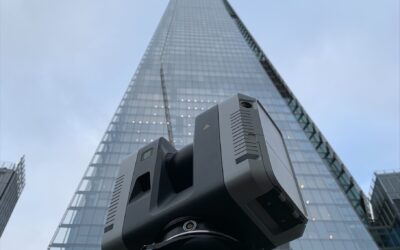
A Leica Scanstation C10 laser scanner was chosen to carry out the survey, due to its reliability, its survey-grade dual-axis compensator, and the accurate and complete high-definition survey data that it can quickly capture. The exterior of the site and its immediate surroundings were captured in high resolution along with the interior of the stair core. Scans were controlled by traditional closed-loop traversing methods and the registration of the scans was further tightened by analysing the geometry of the individual point clouds and calculating a statistical best-fit. The results of the registration left residual differences of no more than 1mm, ensuring that scans were registered together to a very high accuracy.

When our client began to analyse the survey results, they were alarmed to discover that the nature of the deformation was not as had been expected. Technics Group was able to revisit the point cloud data, not only to prove irrefutably the validity of the results, but also to allow additional analysis of the data by the client in line with the unexpected nature of the deformation. This was all done without the need for expensive return visits to site. This is just one example of the many benefits of 3D laser scanning – a powerful survey resource with a multitude of applications.


Contractor fined over worker’s jet of fire burns

Tuesday, January 22nd, 2013

A sub-contractor from Highley has been fined for safety breaches after a worker was burned by a ‘jet of fire’ when he hit an underground electricity cable with a steel pin while replacing pavement edging in Birmingham.

The worker, 38, from Bridgnorth, who does not want to be named, escaped with minor burns to his arms and eyebrows and had his clothing singed when the 415 volt cable sent a ‘jet of fire’ up the steel pin.

An investigation into the incident that took place on 16 August 2011 by the Health and Safety Executive (HSE) found Ricky Paul James, 46, the subcontractor responsible for the work, had incorrectly indentified the location of the live cable.

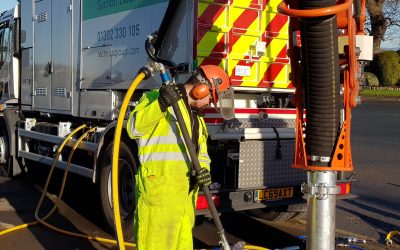
Birmingham Magistrates’ Court heard today (17 January) that Mr James had been subcontracted to undertake the work and provided with information stating there were buried utility services on-site. Mr James was responsible for scanning the pavement with a specialist tool to identify their location before work started.

After wrongly marking where the cable lay, he instructed one of his operatives to carry out the edging work. When the worker wrapped a piece of nylon around the steel pin it made contact with the 415 volt underground live cable and an explosion ‘like a roman candle’ occurred.

Ricky Paul James of Highley, Shropshire, pleaded guilty to breaching Regulation 25 (1) of the Construction (Design and Management) Regulations 2007. He was fined £2,500 and ordered to pay costs of £4,727.

After the hearing, HSE inspector Paul Thompson said:

“The worker is very lucky to be alive. It is only because he was able to quickly jump back from the blast and extinguish the fire that he wasn’t electrocuted. As he struck the pin it caused a ‘Roman Candle’ effect of fire and sparks to erupt from the ground, sending a jet of fire up from the pin.

“It is of vital importance that any buried services present on a construction site are located with diagrams. Their location must be marked and their presence made known to any operative who may work nearby”.

“There are a number of ways of conducting similar work which avoids using steel pins to penetrate the ground.”

This where Technics Group can help you – we are experts in the location, positioning and identification of buried pipes and cables.

Using a variety of equipment and radio frequency and radar methodologies according to Client specifications and required project outcomes, We can provide:-

  • 2D plans to any scale
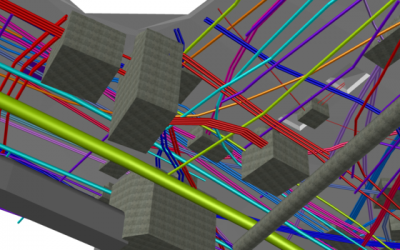
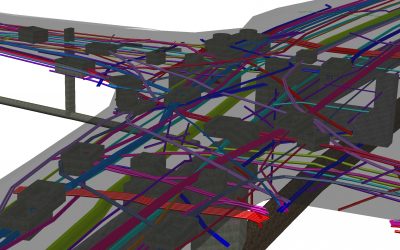
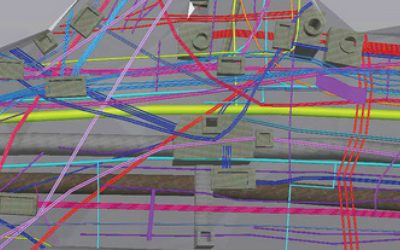
  • 3D models of the site and the utilities
  • CAD drawings linked to GIS databases
  • Desktop analysis of Statutory Authority plans
  • Stat plan verification surveys
  • Cable/pipe route clearance surveys

To discuss your requirements, please call our Project Management Team on 01483 230 080

For further information on buried services, see the HSE’s Publication ‘HSG47: Avoiding danger from underground services‘ available free from the HSE’s website.

The Survey Association (TSA) also publish The Essential Guide to Utility Surveys  the best practice guide on utility surveys for developers and survey practitioners and you can download it for free. Developed in association with member companies (including Technics Group) the HSE, RICS and the ICES, is a must read for anyone in the industry. The TSA video stars our Managing Director and TSA President – Graham Mills.


BIM: What is it all about?

Monday, July 16th, 2012

What is this BIM thing anyway?

Building Information Modelling (BIM) has been around for a while, at least 15 years or longer in the US and over here for a few years.  BIM brings with it lots of new phrases such as BIM Model, Revit Model and Scan to BIM. The UK is technologically under the advancement curve from one perspective and partly dysfunctional in our holistic appreciation and approach to economically and sensitively designing, constructing and managing buildings and their wider infrastructure. In an age of increasingly sophisticated 3D survey data capture and visualisations there is still a huge downgrading of data to traditional simplistic 2D formats in order to satisfy historical requirements and preserve the status quo.

The current UK Government Initiative is driving wider industry professionals from across the board to comply with its suggestions/demands on a steep “BIM” learning curve of enlightenment. This will require investment by all those involved in terms of both capital and time to take-up in order to reap the benefits later. Paul Morrell, the UK Government’s former Chief Construction Officer, has several times publically told the wider construction industry to use technology to the full and “collaborate”- something we British are a little bit reticent to do most of the time. BIM is therefore becoming a euphemism for construction efficiency and green credentials through the vehicle of sharing information.

Of course it’s a fairly big enticement to take-up BIM since all Public sector projects coming in at £5m+ will be required to use the standardised BIM structure methodology which its Task Group has helped to construct- with carrot and stick in perhaps not equal measures. More enlightened private companies however, are already making the connection and leap of faith and making the move over to BIM as their mainstream focus. .

Revit Model

BIM: Son of CAD & GIS (Kalinkski 08)

BIM is greater than the sum of its parts and has traditionally, or currently in the UK, been wrongly thought of as a method for ensuring all design data is delivered in 3D with a building model. Whilst this sounds logically truthful, BIM is in fact a new way of working and more importantly of thinking. It’s a holistic, collaborative process of collecting and Managing Intelligently Modelled Information (MIMI) using the vehicle of various software suites.

There is a real infrastructure or building model, or realistically models, at the heart of the process but it is fundamentally database driven and “intelligent”; combining the best capabilities of both the GIS world and CAD software in a 3D environment.  As Art Kalinkski (August, 2008; Geospatial Solutions) calls it “BIM, Son of CAD & GIS”. He cites CAD as dealing with points, lines, polygons and the quality of data and often focusing on the inert and visual.  Whereas GIS is a topological model that’s linked to a database where each feature can be attributed and “knows” what is next to it and where and  so on and so forth.

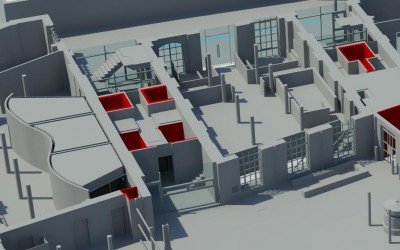
Internal Scan Data

The benefit here is that within the model, features can be quantified, measured and globally changed within the greater model as a whole. So for example a new type of door or window can be replaced with another type of different dimensions and characteristics and the model will update all occurrences and their associated structural openings etc. This of course makes model iteration, or trial and error, a whole lot easier and quicker.

So what is BIM used for?

The current government envisages that the vast majority of its projects will be BIM based in order to drive through their efficiency targets. But of course the likelihood is that this will easily spill over into a high proportion of private initiatives as two-tier multi-method working is something that none of us like doing. The pitch we are given is “think global, act local” and start with our own small BIM and aim towards being a part of Big Bim. This means working on projects in a “BIM format” which form part of a greater whole programme which considers infrastructure and continual joined-up thinking. You can see the worth in principal, but I think the move to the Goldilocks state of just right will be painful because of entrenched ideas, new methodology uptake issues and legacy methods and data.

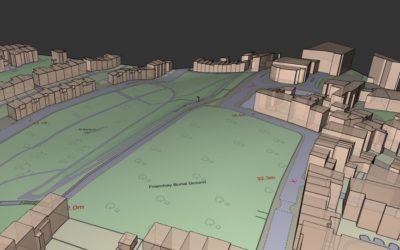
3D land & Building Model

What Value does it add?

The bottom line is that BIM is supposed to generate transparent and tangible mid to long term benefits, any short term gains I would suggest being cancelled by the steep learning curve and investment needed for uptake. So what are these value-added benefits?

The value for design teams and beyond into facilities management is the database driven model which intelligently quantifies attributes and features allowing a wide variety of useful manipulations and quantifications by different professionals working on the project. For example “iterative virtual design” methods are made possible and can be employed which are highly cost effective. This method ensures a greater degree of fit between trial design models being balanced with practical construction considerations and also the reality of building management through these designs being road-tested for bugs by a collaborative team in the virtual environment before groundwork on site even commences.

One quick way of efficiently standardising the “model” content is to adopt the “scan-to-BIM” methodology of laser scanning existing features and buildings and producing point cloud data- thus ensuring that an accurate and robust data set is used at source to add to or create any BIM model. The benefit of this method is that a high degree of detailed subject data and also peripheral scan data is quickly collected in one go. This data may not necessarily be utilised immediately but once collected it can be used at a later date for other aspects of design or iteration or simply visualisation.

External Scan Data

Internal Scan Data

Since BIM as a process has a detailed model at its heart, the visualisation aspects of the methodology are wide ranging; from teams being able to easily appreciate a particular complex construction design in a video digital form as opposed to 2D plan drawings through to experimenting with landscaping aesthetics and building views and building outlook visualisations. These later points are vital for project approval in terms of getting stakeholders buy-in and also for stalling possible protests against the “non-sensitive fit” of certain buildings or architecture within an existing area. Right of Light issues can also be addressed at this early painless stage of development in a proactive manner, thereby removing the need for post construction back-tracking on any discovered legal position.

In addition to this “collect-once-use-many-times” benefit of scan data, the additional project value of as-built scan data being added to existing data sets is a relatively simple and highly effective process. Thus as a development progresses, for instance, it is easy to use the BIM model as a vehicle for on-going and updated programme management. This can be thought of in terms of comparing the design model at a particular stage of development with the “actual development” as analysed in the as-built data model. This method is currently being effectively employed on some very high profile works at a London airport for example.

What are the drivers?

Firstly the key driver is the public sector mandate for projects to be undertaken using BIM methodology. There is also  the strong likelihood of overspill of BIM into private sector operations, which means that in order to continue to supply data to the vast majority of projects (over time) there will be an element of having to keep up with the Joneses in order to stand still as a data provider.

BIM Model

Cut away model

BIM has been used since the early to mid-nineties in the US to reasonable effect if you believe the posts. The software companies, albeit somewhat altruistically, seem to be trying to also grasp the nettle of development by focusing on BIM software development and the whole scan-to-BIM environment. Some of the key players such as Bentley, Autodesk and ArchiCAD are all keen to keep up with their new releases and show good willing to their growing “captive” audiences. I guess that this could at the very least suggest that software companies think this isn’t just a passing fad but actually worth the long term investment it appears to be making.

So What is the Next step?

Well, given that unless there is a serious government and construction U-turn in the coming couple of years then BIM is here to stay-though even without government intervention there is still arguably sufficient impetus already to probably counter any official tap being turned off.  With the advancement in the scan-to-BIM process and methodology and its apparent worth and benefit then this is highly likely to be the preferred way of working and receiving information in the near to mid future. At the same time the whole holistic BIM methodology and the data capture process will both begin to percolate down the user tree to reach the majority of development projects and design and construction users. As the geospatial data becomes more transparent to all users then wider “BIM”, as a work method, will no-doubt become our mainstream business process?

Thus it’s probably time to try it out and also consider what long term investments are needed now in order to facilitate future use considering how steep and long that the effective take-up process will take time, along  with the necessary investment- in these cash scarce times.

At Technics Group we are collaborating with a number of our clients to help each other through the implementation of BIM. We recognise that for our clients to effectively run a project using BIM the survey data has to be compatible from the start.

We are more than happy to be used as a sounding board and to be involved with our clients on their BIM journey so please do contact our Survey Director Martin Penney to discuss how we can work together.

BIM using Revit


Visualising Underground Utilities: A Paradigm Shift

Thursday, June 21st, 2012

For many years we have been able to produce all types of surveys in a 3D format, we measure land and buildings in 3D and we use sophisticated utility location equipment which again allows positioning of the detected utilities in 3D. However for the most part the results and output survey data is still distributed as a 2D CAD file. With the rise of Building Information Modelling (BIM) Technics Group Survey Director Martin Penney has taken a look into how this could affect utility survey data. As a result of Martins investigations he has had an article published in Civil Engineering Surveyor Magazine this month.

Take a look at the article and lets us know what you think:

Direct link: http://mag.digitalpc.co.uk/fvx/ces/1206/?pn=14

Portal: http://ces.digitalpc.co.uk


Top secret bunker, confined space survey

Monday, January 30th, 2012

Technics Group undertakes many weird and wonderful surveys during the year, one of the most notable and interesting of which are the confined space exercises. These usually entail a difficult environment with challenging access and working conditions.

We have a crew of confined space trained staff who with their expert knowledge, experience and pragmatic tenacity always come up with an acceptable and safe method of operation in order to achieve our client objectives.

We recently undertook a preliminary investigation into an ex government underground tunnel and bunker complex at a secret location in Surrey. The bunker, which was a strategic out of London base, has not been used since the war. This project involves a geotechnical investigation, concrete structure investigation, GPR survey and condition survey of the complex which is approximately 10m underground, and will be carried out in phases over the course of the year. This will involve traditional survey methods, laser scanning, GPR and invasive and non-invasive geotechnical works.


As you can see from the smiles on everyone’s faces we love a challenge no matter how dark, wet and cold it is!

For more information take a look at

http://www.technicsgroup.com/land-surveying-services/confined-space-surveys


New Building Information Modelling (BIM) Service Launched

Monday, June 20th, 2011

We are pleased to announce that we now offer a new service – Building Information Modelling (BIM).

Building Information Modelling (BIM) is the process of generating and managing building data during its life cycle. Traditionally Measured Building Surveys have been delivered as 2D floor plans, elevations and sections with some clients requiring full 3D CAD models. BIM is a further leap forward and the end result is an intelligent 3D building model and linked database.

The BIM model can be created from existing building drawings or from a specifically commissioned survey. The model can be used by all members of the development team and it gives rise to a new level of efficiency and will eliminate many of the uncertainties found during the construction phase of the project.

Follow this link to find out more about our BIM Services.


Civil Engineering Surveyor Magazine

Wednesday, June 1st, 2011

Just released is the June edition of Civil Engineering Surveyor Magazine. Published by Chartered ICES, as usual it’s packed with lots of interesting articles to help the profession keep up to date with all the latest news from the industry. Also featured is the video which promotes The Essential Guide to Utility Surveys by The Survey Association. The guide, which is endorsed by Chartered ICES, is essential reading for anyone involved with either instructing Utility Mapping or service providers.

Technics Group wrote parts of the guide and are actively involved with using the guide and promoting its use to the widest audience.

Take a look at Civil Engineering Surveyor magazine at http://mag.digitalpc.co.uk/fvx/ces/1106/


Laser Scanning Disused Quarry

Friday, May 20th, 2011

The client request was simple, “can you provide us with a contour model of our site in Guildford”, the challenge was that the site was a sheer sided disused 25m deep chalk quarry. Health and Safety considerations meant that the quarry sides or base could not be accessed by the survey team to take measurements. The solution was to undertake the survey using a Riegl Laser Scanner with a Nikon digital camera mounted on top.  The scanner records up to 122,000 points per second and has a range of 600m whilst being able to achieve a 3mm accuracy.

The Laser Scanning Survey was undertaken in half a day on site, a point cloud was then produced and a contour model derived from that.

To find out more information about how Laser Scanning could benefit your projects and to take a look at the video see our webpage:  http://www.technicsgroup.com/land-surveying-services/3d-laser-scanning#!prettyPhoto/1/


Utility Reports save you time, money, hassle and reduce risk.

Wednesday, March 30th, 2011

If you are planning or designing any sort of works, construction, excavation or M&E feasibility study then one of your first considerations is likely to be what utilities will be affected. There is now a bewildering amount of Utility Companies with varying amounts of pipes and cables covering the country. In London alone there are over 20 companies with fibreoptic cable installations. There is no central register for the hundreds of Utility Companies and yet it is essential that you know what will affect your project.

Digitised Combined Utility Plan

Quite often there is a legal requirement by Local Authorities and under NRSWA 91 for example for a utility report to be compiled and be analysed by the contractor. When any sort of pro-active construction begins then contractors are also bound to take the advice of HSG 47, the H&S guide to safe digging around utilities. This advises the Contractor to consult with record drawings.

Understanding which utilities will be affected by your proposals is absolutely vital in order to manage risk, costs and make planning time more effective and safer for your company. So where do you start with applying to the hundreds of different Utility Companies and how much time and money will it cost?

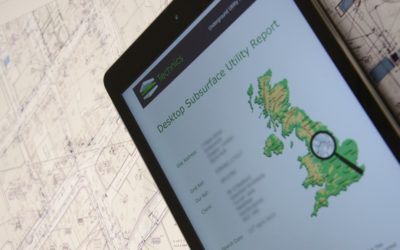
Our Desktop Utility Report service is tailored to your needs. As utility surveyors we have over 20 years experience and have the knowledge and contacts to ensure that you have the data to enable you to calculate your risks. We take the hassle out of acquiring utility plans. With a simple ordering process we will investigate your site and provide intelligence regarding all the key services: Electric, Water, Sewers, Gas, Telecoms, Cable, Fuel & Oil. The end result is a quickly compiled and professionally presented digital report containing all our findings along with contact details of all the suppliers should you need to contact them directly at a later date. We can also digitise the supplied utility drawings and overlay them on one AutoCAD drawing.

Our service doesn’t stop there. As utility mapping surveyors we are perfectly placed to offer advice and consultation on wider utility issues and also provide investigation services to complement your planning or construction phase. We can undertake land surveys of your sites, provide radio-detection and ground penetrating radar intelligence and map all our findings alongside the utility plans into one survey drawing- a complete solution.

For more information see: http://www.technicsgroup.com/land-surveying-services/utility-reports-desktop

Digitised Combined Utility Plan


Utility Tracing compared to Utility Company Record Drawings

Tuesday, March 8th, 2011

Traditionally, highway infrastructure redevelopments, civil engineering projects, utility diversions and even single excavations are designed around the information contained in utility company record drawings.  This is still seen by some as an essential practise, but, just how accurate are record drawings that are sourced from the various utility companies?  This is a difficult question to answer as the accuracy of these records can vary dramatically from company to company and even from area to area within the same service company.

Technics Group were commissioned by a major organisation, who were concerned with this situation, to evaluate the benefits of an accurate Utility Mapping Survey over the information supplied by Statutory Undertakers.

Using the most comprehensive and reliable utility tracing methodology possible, an entire central London site was thoroughly investigated using Radio Location and Ground Penetrating Radar, a 3D model of all detected services was then produced.  The client then conducted a significant number of excavations around the site to verify the accuracy of the survey results.

Following this all the record drawings from all the utility companies that had any plant in the area were accurately digitised, using the OS background maps as the common feature.  Within a CAD environment, the utility record drawing information was laid over the survey results and cross sections generated at 10m intervals around the site.  Each section was then analysed and the horizontal distance measured between the record position and the traced position for each service.

The resulting statistics surprised everyone involved and certainly proved the case for using accurate and reliable utility information, to base important design and excavation decisions on.  The headline statistics included:

  • Average plan distance error was 1.6m across all utilities measured, with largest recorded error being 7.17m.
  • An additional 186 buried linear features were detected that were not described on any utility record drawings.
  • 61 utility services were detected within 200mm of the surface of the ground within the area.

Admittedly this is only a tiny snapshot of the national situation; however, would you be happy for your designs to be based on this level of accuracy?  Indeed, would you be happy knowing that your personnel are excavating in areas that these plans show to be risk free? Our client for this project now instructs Utility Mapping at the earliest opportunity for each new project.

Below are some examples of individual utility record drawing positions (Blue) versus traced positions (Red):