The Technics Group Surveyor Blog

Thank you Derry

May 24th, 2013 by Graham Mills

Our Business Development Director Derry Long has regrettably left Technics Group

We would like to take this opportunity to thank Derry for all his hard work and dedication in promoting our brand. He has created a wider network for our company to evolve.

We hope to continue our working relationship with Derry in some capacity in the future.

We wish Derry and his family all the success in the future.

Thanks again ‘Mr MIPIM’

Leave A Comment


Carry On Sailing

May 22nd, 2013 by Graham Mills

Chairman Graham Mills recently spent 2 nights on board yacht for team building and learning to splice the Main Brace

The event was organised by the Group 5 of Vistage International the CEO support organisation which aims to help members become more effective leaders and run more successful businesses.

Each year the Group holds a retreat to reflect upon business, organisation and personal goals and work through various options. This year the vehicle for this exercise was a hands-on experience sailing two 37ft Beneteau Oceanis yachts around the Solent. The crew of 6 in each yacht learnt the basics of Seaman ship and team-work which they vowed they would take back to the work place- though they weren’t too sure about the rum rations. Day two saw their new skills put to the test with a head to head race from Cowes to Hamble. Captain Pugwash thought that the best way to show true leadership was to purchase a Captains hat which he can be seen sporting here complete with fetching waterproofs, proving the adage that it’s impossible to carry off elan whilst afloat on a large caravan. Though the experience was obviously personally significant as Graham is considering the purchase of a pedalo.

Hello Sailor!

Leave A Comment


MIPIM – The MD’s View

April 8th, 2013 by Derry Long


John Macintyre - Managing Director Technics Group

Technics Group Managing Director John Macintyre presents his thoughts about his recent trip to MIPIM.

I was genuinely looking forward to the MIPIM challenge – 4 days of networking with over 20,000 property delegates, oh yes and it   was in Cannes!

I took the time out before our trip to read our Blog – TG tips which proved very helpful, along with the official MIPIM website & Facebook page to help me set the scene.

As it turned out, just getting into Gatwick in the early hours of Tuesday morning in the snow provided its own challenge. Thankfully we timed it just right & our flight was not delayed. Once we dumped out bags into our hotel we were straight into action – hosting a lunch on the beach.

The London Pavilion was a feature of our week, especially when Boris Johnson delivered his speech following the arrival of the London to Cannes cyclist which included the Olympic Silver medallist Elizabeth Armistead. Viewing the model of London gave me a sense of pride to be part of the development works within our vibrant city.

I had many discussions with delegates regarding the benefits of MIPIM and how they measured the success of time in Cannes. The patrons agreed it had become more focused, people were maximizing their time and arranging meetings in advance of the week. I was pleasantly surprised with how relaxed everyone was, which allowed me to get to know the individuals inside the company rather than just a name on a business card.

The extensive networking continued all the way to the Baggage Hall at Gatwick Airport on Friday Night.

The hard work has already started with following up all our new contacts. Developing clients relationships is something Technics Group excel at, MIPIM has given us a greater platform to achieve this.

I’m confident you’ll see me again in Cannes in 2014 !

Leave A Comment


BIM: What’s in it for Survey?

March 25th, 2013 by Derry Long

Geomatics World recently interviewed Derry Long on the subject of BIM

BIM is used most productively when it is applied to new building projects and, with the help of government, it has been pushed hard by the design software companies. Everything is new, from foundations upwards. Land surveyors are involved in surveying the site to show the area of land available and its relationship to existing structures and infrastructure and then, during construction, they may be hired to do setting out-work. Beyond that, their involvement is usually minimal and fragmented. However, there is the opportunity to be involved during the whole project life-cycle in providing as-built data, independent Industry QA and also providing a “basic” BI Modelling capability, to ease workflow. Since on-going and timely accurate and appropriate data is key to any fast-paced project there is also a role for surveyors to consult with the industry on the best methods and options for providing such data.

BIM for life

The focus has so far been on design and construction, but BIM is intended to run throughout the whole life of the building, up to and including decommissioning. Derry Long points out that very little has been said on what happens to the model when the site is handed over at the end of the construction period. During the lifetime of the building there will be a need to maintain the building model. If not maintained, it will soon go out of date, become unreliable and will lose its value. It is still unclear just who will do this maintenance work. Will it be work for facilities management companies, in-house maintenance staff or maybe survey companies will offer to keep the BIM up to date for the custodian? In order for this to be even explored there needs to be a greater integration of the project’s end-users as key stakeholders at the conception of a building and also in the maintenance of transfer of the BIM dataset.

As-built BIM

One aspect of BIM that has not been fully appreciated and explored is the value of the data and its reliability and currency. As we all know, it is rather easier to survey objects that you can see than those that are hidden and yet, for refurbishment projects it is usually the hidden objects, like a building’s steel structure that are specifically required and are vital to the project. As-built spatial information about these objects therefore has high value. These may be recorded on drawn ‘as-built’ drawings which are most likely to be design drawings stamped ‘as-built’ and then not maintained. A BIM used for construction will show the design position of structural members in the same way. Will engineers working on a refurbishment in twenty years’ time be willing to trust a BIM model any more than they presently regard as-built drawings?

In theory, the collaboration that goes into the BIM process should mean that buildings do match the design much more closely; and much has been made of the greatly reduced design changes that result when BIM is used to “virtually build and test” before going to site. However, there will always be as-built differences and surveyors could measure these during construction, when they are visible. Derry Long suggests that ongoing surveys should be made during construction with a view to recording the as-built position of detail, such as structural steelwork, and in real time, to capture it before it is covered up by finishes and decoration. The important point is that it is this valuable data that will be needed later in the life of the building when it will be difficult and costly, if not impossible, to survey. This is the equivalent of surveying underground utilities when they are visible in the trench, before backfilling. A brilliant idea, but how often does it happen?

Never or rarely, is of course the standard response, because the organisation paying for the survey is unlikely to be the one benefiting when the data is needed much later in the life of the building. However, this is not the only front-loading of fees on the entire project. The iterative virtual design process and sharing of data between critical professionals will largely happen in the early stages of the project in order to prevent pushing problems and issues further down the project line. How the fee paying client buys into this concept is currently far from certain.

BIM for refurbishment

Traditionally, most survey involvement has been with refurbishment of buildings. These are as-builts but will never be ‘complete’ because surveyors cannot see beneath the surface of the plaster without removing it. A measured building survey of an existing building will therefore never be as complete as a full (as-built) BIM. Without the detail within and of the walls, floors and ceilings, it is hard to see how any survey of an existing building can claim to be a full BIM. BIM ready or partial BIM – perhaps! So how will the world of BIM cope with incomplete building data? Laser scanning is part of the answer, but it is unfortunately being promoted by non-surveyors as a panacea. As so frequently is the case, the technology has been oversold and the expertise in using the data undersold. Martin Penney – survey director at Technics Group suggests: “The second part of the answer is providing the bulk of a BIM ready model, which simply allows the various end-users to then update the building fabric with specifics of type and finish. That is, allowing the ultimate users to focus on what they do best.” David Maltby also reckons that survey companies have not been proactive in communicating effectively with clients to solve their problems. He takes as an example a project to survey schools for a county council. The price for any survey company to carry out the whole job itself was never going to fly, so the solution suggested, and adopted, was for the firm to survey the building footprints and then train permanent and temporary council staff to survey the interiors; expertise that the council has retained for maintenance purposes.

BIM is not for all

It is also false to imagine that 3D BIM modelling will be suitable for every construction job and even when surveyors are asked to produce data for BIM, the specific level of detail required will vary. Derry Long sees a Survey Industry BIM specification and Specific Guidance Notes to practitioners, alongside training as a critical step forward, but says that this will take huge effort and perhaps most importantly support and buy-in from the industry itself in order to make it happen. Time is also against the industry as we are starting to bid for BIM tenders and projects alongside the normal survey requests, so impetus is building and the industry as a whole is no yet ready. He sees it as damaging for the industry if through a lack of wider professional guidance individual companies were to each produce their own specifications in order to make-do in the short term. We need to tackle the medium term now. Measured building models are part of BIM, but BIM is really about processes, data and collaboration. One aspect that measured building surveyors could tackle more effectively is the spatial planning issue that goes hand in hand with building refurbishment. Maltby says that clients are reluctant to have buildings surveyed that are going to be demolished, and yet it is an important part of the process to find out what space is being used in the old building in order to plan and build temporary accommodation (or the refurbished or replacement buildings). It may not be BIM as portrayed in the movies but planning of temporary works is none the less a vital part of the process and 2D is perfectly adequate.

Let’s be part of it

The survey Industry as a whole is beginning to wake up to the BIM notion and like everything there are the early adopters, avoiders and late adopters. Either way the industry needs drawing together on this topic for surveyors to make a coherent and concerted effort to be a part of the next generation of building management – from cradle to grave, or from site survey to occupation and ultimately redevelopment.

“This article first appeared in Geomatics World March/April 2013 and is reproduced with the permission of the author, editor and publisher.” 

The article was written by Richard Groom and features contributions from David Maltby of MBS Survey Software Ltd and Martin Penney of Technics Group.

Geomatics World –  is the trade Magazine of the Geomatics Industry . 

Leave A Comment


Technics Group attend the #RICSBIM Annual Conference 2013

February 22nd, 2013 by Derry Long

Martin Penney – Technics Group Survey Director recently attended the Royal Institution of Chartered Surveyors (RICS for their annual BIM Conference.

The annual RICS BIM conference was very well attended in London last week by a wide cross-section of the industry including Government, academia, architectural practices, QS, facilities management and legal; Geomatics was the only under-represented sector as usual:

  • David Philip (Head of BIM Implementation, Cabinet Office)
  • Steve Race (BIM Ambassador, CIC)
  • Deborah Rowland (Head of Facilities Management, Cabinet Office)
  • Dirk Krolikowski (Associate/Architect at Rogers Stirk, Harbour + Partners)
  • Nick Nisbet (Director, AEC3 UK Ltd)
  • Dale Sinclair (Director, Dyer & Chairmain of RIBA Plan of Work Review Group)
  • Paul Fletcher (Co-founder Director, Through Architecture)
  • Professor David Greenwood (BIM Academy and Northumbria University)
  • Adrian Malone (Director, Faithful+Gould)
  • Michael Conroy Harris (Principal Legal Manager, Eversheds)

The main theme of the conference was moving away from “Why BIM?” to “How BIM” across the whole Facility lifespan, with a focus upon Change Leadership in the wider industry and looking specifically at the nuts and bolts of interoperability, collaboration, support and training and education. Interestingly the point was made about the industry BIM hype and myth and the fact that BIM was 20% Technology and 80% People and Processes- which is usually where we all get it wrong!


The conference presentations are available through the RICS, but one of the most notable points to take away was David Philip’s announcement that 28th February 2013 would see the launch of the Digital Plan of Work (DPOW) and associated work elements via the Cabinet Office’s Task Group website (http://www.bimtaskgroup.org/). This will allow professionals to use a vast array of on-line material and templates and also to store data.

Additionally this date will also see the launch of the PAS 1192:2. This User Guide is a tailored code of practice or specification for information management when using Building Information Modelling (BIM) Technologies within a project. The framework of standards, processes and collaborative working practices are designed to specifically meeting the Government’s desired outcome of reducing capital expenditure (CAPEX) out-turn costs by ensuring Level 2 BIM Maturity by 2016.


Also present at the conference were a number of BIM methodology software suppliers who ran demonstrations of their various wares. If you missed out on the conference, you can see some of the discussions on Twitter by searching for the #RICSBIM hashtag

Technics Group specialise in capturing information about the existing Built Environment. For BIM of existing structures, it is critical that the information is correct before any further modelling work is undertaken. We use all forms of techniques to capture information including Laser Scanning. For further information please do get in touch with us.

Leave A Comment


Martin Penney represents TSA at recent English Heritage BIM Conference

February 19th, 2013 by Derry Long

Fort Cumberland situated on Eastney Point at the entrance to Langstone Harbour on the Hampshire Coast was the impressive venue for English Heritage’s BIM Strategy Seminar in January.

The current remaining pentagonal fortification dates back to an early earthwork battery of 1716 and was the brainchild of William Duke of Cumberland- erstwhile of the Jacobite Rebellion and the Battle of Culloden. Built to control the entrance to Langstone Harbour with its impressive arsenal of 34 interlocking-arc guns, this strategic position also helped to defend the access to Portsmouth Harbour and its docks to the West.

Fort Cumberland. Photograph courtesy of English Heritage

Strategy was also the order of the day at the conference along with discussion and understanding as various speakers considered the role of data within English Heritage (E.H.) and the meaning and possible uses of Building Information Modelling (BIM) as a potential future business model for E.H.

Technics Group Martin Penney, Survey Director, spoke on behalf of The Survey Association (TSA) and the private sector view of BIM, citing the current wide interest but also confusion and uncertainty within the Land Survey community as to its possible long term role. Penney said “It’s a privelage to be invited here by English Heritage and we hope to be able to provide support and assistance to them in their future exploration and application of BIM. These are very exciting times for them and the wider survey industry”.

The day was very positive and many views were exchanged resulting in the E.H. BIMSIG realising that they potentially had a long road of investigation ahead of them before needing to confirm their BIM strategy next year.

Many thanks to Paul Bryan of English Heritage.

Leave A Comment


Technics Group are attending MIPIM 2013

February 12th, 2013 by Derry Long

Once again Technics Group will be attending Marché International des Professionnels d’Immobilier which translated means International market of the Professionals of Real Estate or simply known to all as MIPIM.

The event takes place from 12th – 15th March in Cannes on the French Riviera and is the event for property professionals throughout the world.

John Macintyre (our Managing Director), Derry Long (our  Business Development Director) and Graham Mills (our Chairman) will be attending as delegates as part of the London Pavillion.

Around 18,000 delegates from around the world attend this annual conference with nearly 3,500 attending from the UK. This will be Derry’s 11th year attending.

If you are going to MIPIM and you would like to meet up for a chat and a drink, then please drop us a line.

John Macintyre can be contacted on +44 7710 172465, Derry Long can be contacted 0n +44 7866606107 and Graham Mills can be contacted on +44 7836 517229

Follow us at the event via Twitter at @TechnicsGroup

Leave A Comment


Technics Group appoint new Managing Director

February 11th, 2013 by Derry Long

Technics Group, one of the largest survey companies located in the South East, has appointed John Macintyre as Managing Director. John was previously Operations Director of Technics Group, responsible for managing all survey projects. Founder and former Managing Director Graham Mills is now Chairman of the Group. The company has recently seen significant business growth with new clients across many sectors including construction, retail and utilities. Technics Group was also recently voted Best Surveying and Property Services Company in the Surrey Property Awards 2012.

John Macintyre - Managing Director Technics Group


John Macintyre, Managing Director of Technics Group said: “I am delighted to take on my new role in Technics Group. Over the last few years we have consistently delivered projects to clients with both above and below groundSurveying Services for companies in different sectors. Our success in the recent Surrey Property Awards is great recognition from our clients.”

Graham Mills - Chairman Technics Group

Graham Mills, Chairman added; “Technics Group has built upon its reputation for delivering quality survey services to clients. As Chairman I look forward to being able to focus on new projects and my role as President of the Survey Association, confident that Technics Group will continue to thrive under its new management team.”

Business Development Director Derry Long and Technical Survey Director Martin Penney will continue in their current roles in the company.

Leave A Comment


Laser Scanning – Verticality Deformation Survey

January 22nd, 2013 by Derry Long

Technics Group were recently appointed to carry out a verticality deformation survey of a block of flats in Canterbury, Kent.

The site was a modern, three-storey block in a small residential development and consisted of two wings conjoined by a shared stair core. The interior exhibited some severe cracking suggesting a serious subsidence issue, which had led to the building being deemed uninhabitable and the relocation of the residents.

Structural Engineers David Osborne Associates commissioned  Technics Group to undertake the survey as part of their investigation and remedial design work.
The project requirement was to produce tabulated results showing deflections from vertical of the exterior walls and interior stair core walls at 31 plan positions, each at 10 level intervals from ground to soffit.


A Leica Scanstation C10 laser scanner was chosen to carry out the survey, due to its reliability, its survey-grade dual-axis compensator, and the accurate and complete high-definition survey data that it can quickly capture. The exterior of the site and its immediate surroundings were captured in high resolution along with the interior of the stair core. Scans were controlled by traditional closed-loop traversing methods and the registration of the scans was further tightened by analysing the geometry of the individual point clouds and calculating a statistical best-fit. The results of the registration left residual differences of no more than 1mm, ensuring that scans were registered together to a very high accuracy.

When our client began to analyse the survey results, they were alarmed to discover that the nature of the deformation was not as had been expected. Technics Group was able to revisit the point cloud data, not only to prove irrefutably the validity of the results, but also to allow additional analysis of the data by the client in line with the unexpected nature of the deformation. This was all done without the need for expensive return visits to site. This is just one example of the many benefits of 3D laser scanning – a powerful survey resource with a multitude of applications.

Leave A Comment


Contractor fined over worker’s jet of fire burns

January 22nd, 2013 by Derry Long

A sub-contractor from Highley has been fined for safety breaches after a worker was burned by a ‘jet of fire’ when he hit an underground electricity cable with a steel pin while replacing pavement edging in Birmingham.

The worker, 38, from Bridgnorth, who does not want to be named, escaped with minor burns to his arms and eyebrows and had his clothing singed when the 415 volt cable sent a ‘jet of fire’ up the steel pin.

An investigation into the incident that took place on 16 August 2011 by the Health and Safety Executive (HSE) found Ricky Paul James, 46, the subcontractor responsible for the work, had incorrectly indentified the location of the live cable.

Birmingham Magistrates’ Court heard today (17 January) that Mr James had been subcontracted to undertake the work and provided with information stating there were buried utility services on-site. Mr James was responsible for scanning the pavement with a specialist tool to identify their location before work started.

After wrongly marking where the cable lay, he instructed one of his operatives to carry out the edging work. When the worker wrapped a piece of nylon around the steel pin it made contact with the 415 volt underground live cable and an explosion ‘like a roman candle’ occurred.

Ricky Paul James of Highley, Shropshire, pleaded guilty to breaching Regulation 25 (1) of the Construction (Design and Management) Regulations 2007. He was fined £2,500 and ordered to pay costs of £4,727.

After the hearing, HSE inspector Paul Thompson said:

“The worker is very lucky to be alive. It is only because he was able to quickly jump back from the blast and extinguish the fire that he wasn’t electrocuted. As he struck the pin it caused a ‘Roman Candle’ effect of fire and sparks to erupt from the ground, sending a jet of fire up from the pin.

“It is of vital importance that any buried services present on a construction site are located with diagrams. Their location must be marked and their presence made known to any operative who may work nearby”.

“There are a number of ways of conducting similar work which avoids using steel pins to penetrate the ground.”

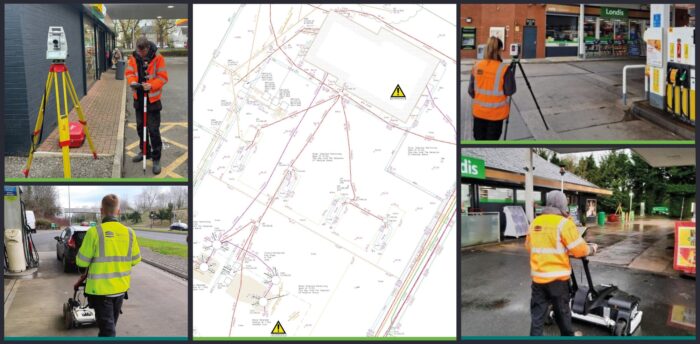
This where Technics Group can help you – we are experts in the location, positioning and identification of buried pipes and cables.

Using a variety of equipment and radio frequency and radar methodologies according to Client specifications and required project outcomes, We can provide:-

  • 2D plans to any scale
  • 3D models of the site and the utilities
  • CAD drawings linked to GIS databases
  • Desktop analysis of Statutory Authority plans
  • Stat plan verification surveys
  • Cable/pipe route clearance surveys

To discuss your requirements, please call our Project Management Team on 01483 230 080

For further information on buried services, see the HSE’s Publication ‘HSG47: Avoiding danger from underground services‘ available free from the HSE’s website.

The Survey Association (TSA) also publish The Essential Guide to Utility Surveys  the best practice guide on utility surveys for developers and survey practitioners and you can download it for free. Developed in association with member companies (including Technics Group) the HSE, RICS and the ICES, is a must read for anyone in the industry. The TSA video stars our Managing Director and TSA President – Graham Mills.


Leave A Comment